
Keywords
pressure algometry
temporal summation
wind-up
conditioned modulation of pain.
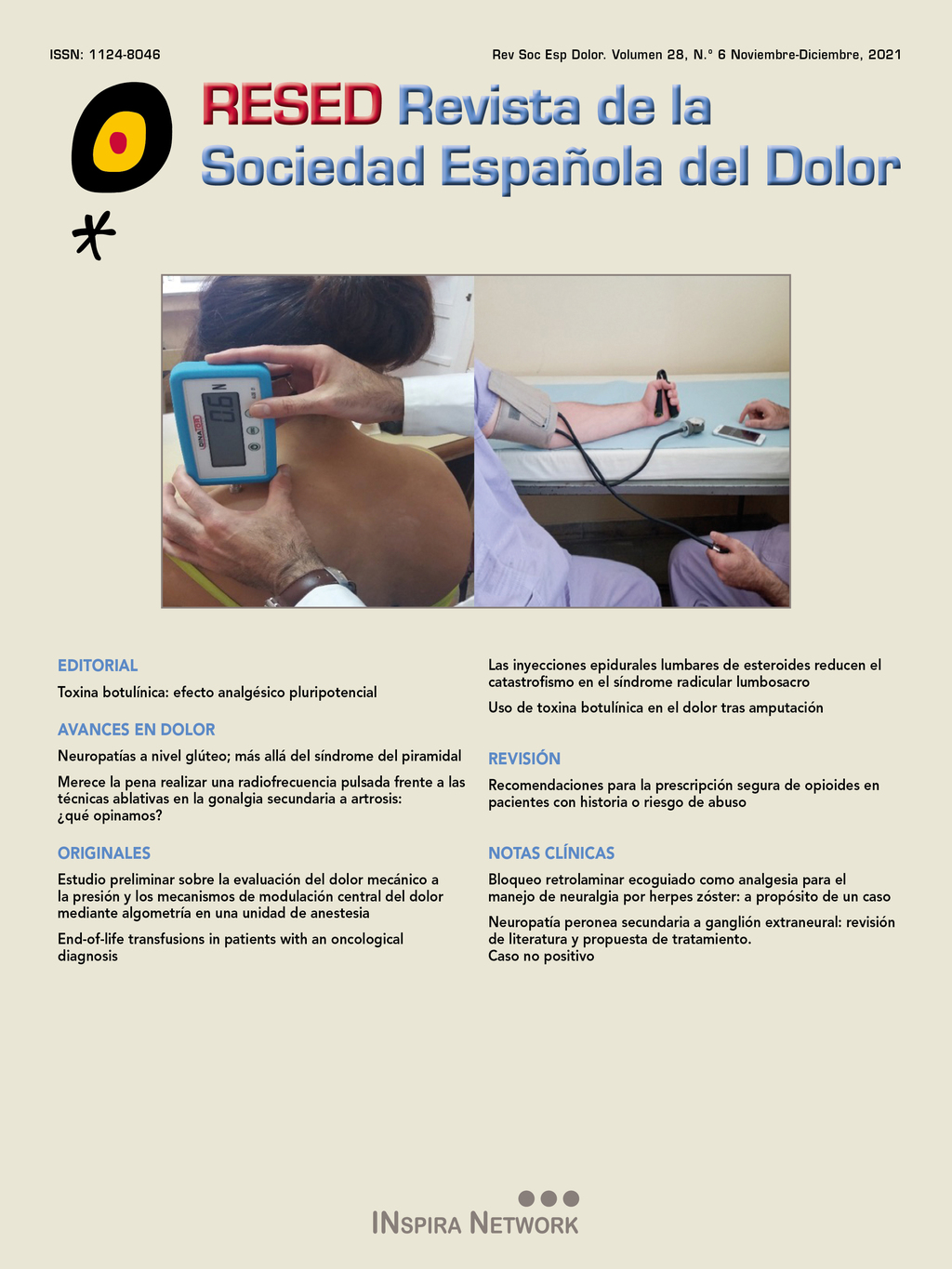
Abstract
Introduction: Pressure algometry is a valid method to evaluate the sensory system of pain transmission in humans, using tests such as temporal summation and conditioned modulation of pain. The objective of this work was to carry out a preliminary experience in the Anesthesiology Service of our University Hospital, using pressure algometry as a quantitative sensory test. Methodology: In a first stage, a cross-sectional case-control study was carried out, without randomization, where the pressure pain threshold was measured by pressure algometry in 58 patients who consulted in the preoperative evaluation visit. Eighteen had some type of chronic pain (pain group) and 40 had no pain (pain-free group). In a second stage, an observational study was carried out on 36 healthy volunteers, anesthesiology residents. Temporal summation was studied in 16 and conditioned modulation of pain in 20, in both cases using pressure algometry. The application of cuff pressure to the arm was used as a heterotopic stimulus. Both tests were measured at the level of the right trapezius muscle. Results: In the group with pain, the pressure pain threshold value was lower than in the group without pain in all the points evaluated. The pain threshold value at the mean pressure of the four regions analyzed in the group with pain, turned out to be lower than in the group without pain, 32.7 ± 10 Newtons versus 42 ± 11.7 Newtons (p = 0.004). The mean pressure pain threshold was lower in female patients than in male patients, 36.6 ± 9 Newtons versus 48 ± 11 Newtons (p = 0.001). In the 20 healthy volunteers who underwent the conditioned modulation of pain test at the trapezius level, the pain threshold at the initial pressure was 63 ± 27 Newtons and the final pressure was 72 ± 28 Newtons, with an average increase of 9 Newtons (14.2 %). In the 16 in which the temporal summation test was carried out, it was found that the pain level of the numerical visual scale went from 4.1 ± 1.0 to 6.5 ± 1.5 between the first and tenth stimulus. Conclusions: The application of pressure algometry in patients who consulted in the preoperative polyclinic, showed that pain thresholds at mean pressure were lower in female patients with chronic pain. In healthy volunteers, temporal summation showed an increase in pain intensity as a normal expression of the "wind-up" phenomenon. In 80 % of healthy volunteers, conditioned pain modulation resulted in an increase in pressure pain threshold with the application of a heterotopic pain stimulus. Pressure algometry is a useful and practical instrument. The information obtained with the quantitative sensory tests can be very useful in the Acute and Chronic Pain Units.References
1. Avellanal M, Riquelme I, Díaz-Regañón G. Test sensitivos cuantitativos (“Quantitative Sensory Testing”) en el diagnóstico y tratamiento del dolor. Breve revisión y propuesta de protocolización de empleo. Rev Esp Anestesiol Reanim. 2020;67(4):187-94.
2. Mackey IG, Dixon EA, Johnson K, Kong JT. Dynamic quantitative sensory testing to charactize central pain processing. J Vis Exp. 2017;(120):e54452.
3. Tesarz J, Gerhartdt A, Leisner S, Janke S, Treede RD, Eich W. Distinct quantitative sensory testing profiles in nonspecific chronic back pain subjects with and without psychological trauma. Pain Journal. 2015;156(4):577-86.
4. Starkweather AR, Heineman A, Storey S, Rubia G, Lyon DE, Grenspan J, et al. Methods to measure peripheral and central sensitization using quantitative sensory testing: A focus on individuals with low back pain. Applied Nursing Research. 2016;29:237-41.
5. Goubert D, Danneels L, Graven-Nielsen T, Descheemaeker F, Meeus M. Differences in Pain Processing Between Patients with Chronic Low Back Pain, Recurrent Low Back Pain, and Fibromyalgia. Pain Physician. 2017;20(4):307-18.
6. Plata-Muñoz ME, Castillo Olivares ME, Guevara-Lópéz F. Evaluación de afrontamiento, depresión, ansiedad e incapacidad funcional en pacientes con dolor crónico. Rev Mex Anestesiol. 2004;27(1):16-23.
7. Blumenstiel K, Gerhardt A, Rolke R, Bieber C, Tesarz J, Friederich HC, et al. Quantitative sensory testing profiles in chronic back pain are distinct from those in fibromyalgia. Clin J Pain. 2011;27(8):682-90.
8. Jason R, Giesbrecht, Battié MC. A Comparison of Pressure Pain Detection Thresholds in People With Chronic Low Back Pain and Volunteers Without Pain. Physical Therapy. 2005;85(10):1085-92.
9. Hitt HC, McMillen RC, Thornton-Neaves T, Koch K, Cosby AG. Comorbidity of obesity and pain in a general population: results from the Southern Pain Prevalence Study. J Pain. 2007;8(5):430-6.
10. Rolke R, Magerl W, Andrews Campbell K, Schalber C, Caspari S, Birklein F, et al. Quantitative sensory testing: A comprehensive protocol for clinical trials. Eur J Pain. 2006;10(1):77-88.
11. Skovbjerg S, Jorgensen T, Arendt-Nielsen L, Ebstrup JF, Cartensen T, Graven-Nielsen T. Conditioned pain modulation and pressure pain sensitivity in the adult Danish general population: The Dan Fund Study. J Pain. 2017;18(3):274-84.
12. Fisher AA. Pressure algometry over normal muscles. Standard values, validity and reproducibility of pressure threshold. Pain. 1987;30(1):115-26.
13. Amexis F, Ferreira C, Klüver A, Laborde L, López C, Ruggiero S, et al. Frecuencia de ansiedad y depresión en pacientes coordinados para cirugía electiva en el Hospital de Clínicas Manuel Quintela. Rev Chil Anest. 2021;50(4):582-7.
14. Othman R, Jayakaran P, Swain N, Dassanayake S, Tumilty S, Mani R. Relationships Between Psychological, Sleep, and Physical Activity Measures and Somatosensory Function in People With Peripheral Joint Pain: A Systematic Review and Meta-Analysis. Pain Pract. 2021;21(2):226-61.
15. Rhudy JL, Meagher MW. Fear and anxiety: divergent effects on human pain thersholds. Pain. 2000;84(1):65-75.
16. Marcuzzi A, Wrigley PJ, Dean CM, Adams R, Hush JM. The long-term reliability of static and dynamic quantitative sensory testing in healthy individuals. Pain. 2017;158(7):1217-23.
17. Pud D, Granovsky Y, Yarnistsky D. The methodology of experimentally induced diffuse noxious inhibitory control (DNIC)-like effect in humans. Pain. 2009;144(1-2):16-9.
18. Treede RD. The role of quantitative sensory testing in the prediction of chronic pain. Pain. 2019;160(Suppl. 1):S66-69.
19. Edwards RR. Individual differences in endogenous pain modulation as risk factor for chronic pain. Neurology. 2005;65(3):437-43.
20. Patel KV, Amtmann D, Jensen MP, Smith SM, Veasley C, Turk DC. Clinical outcome assessment in clinical trials of chronic pain treatments. Pain Rep. 2021;6(1): e784.