doi.org/10.20986/resed.2026.1197
ORIGINAL
Chemical neurolysis with alcohol in the gasserian ganglion in difficult-to-control cancer facial pain: case series
Neurólisis química con alcohol en el ganglio de gasser para el manejo del dolor facial oncológico refractario: serie de casos
Bilena M. Molina Arteta1
Edna M. de la Hoz2
Angélica M. Cetina3
Marcela Hernández Osorio4
1Specialist in Anesthesiology, sub-specialization in Pain Medicine and Palliative Care,Instituto Nacional de Cancerología. Bogotá, Colombia
2Pain and Palliative Care Specialist. Clinicas Colsanitas. Bogotá, Colombia
3Pain and Palliative Care Specialist. Universidad Militar Nueva Granada. Bogotá, Colombia
4Pain and Palliative Care Resident. Fundación Universitaria Sanitas. Bogotá, Colombia
ABSTRACT
Objectives: To evaluate the impact of chemical neurolysis with alcohol in the Gasserian ganglion in patients with refractory cancer-related facial pain, assessing its effect on pain reduction, opioid consumption, safety, and tolerability.
Materials and methods: A case series study was conducted in ten patients with recurrent or progressive head and neck neoplasms, treated between 2021 and 2023. A neurolytic block of the Gasserian ganglion was performed using 0.5 ml of absolute alcohol, preceded by a diagnostic block with 1 % lidocaine at the same dose and guided by CT with contrast medium. Pain scores on the visual analog scale (VAS) were analyzed before, immediately after, at 8 and 30 days post-procedure, along with opioid consumption measured in oral morphine equivalent daily dose (MEDD). Adverse effects and complications related to the procedure were also recorded.
Results: The mean age of patients was 62 ± 16.1 years. The average VAS decreased from 9.20 ± 1.14 before the procedure to 1.40 ± 1.90 immediately after, with values of 2.30 ± 2.71 at 8 days and 1.60 ± 1.67 at 30 days. The mean opioid consumption initially decreased (55 mg MEDD at baseline vs. 49 mg at 8 days) but increased to 58.4 mg at 30 days without requiring additional therapies. No severe complications were reported, and all patients experienced pain relief.
Conclusions: Chemical neurolysis of the Gasserian ganglion with alcohol is an effective and safe alternative for managing refractory cancer-related facial pain. Its application significantly reduces pain intensity, improves patients’ quality of life, and may contribute to decreasing opioid consumption. This study highlights the relevance of interventional procedures in addressing complex cancer pain, providing a valuable field of research for the scientific and clinical community, with potential for future studies in this area.
Key words: Cancer pain, trigeminal ganglion, facial pain, head and neck neoplasms, case reports
RESUMEN
Objetivos: Evaluar el impacto de la neurólisis química con alcohol en el ganglio de Gasser en pacientes con dolor facial oncológico refractario, analizando su efecto en la reducción del dolor, el consumo de opioides, la seguridad y la tolerabilidad.
Material y métodos: Se realizó un estudio de serie de casos en diez pacientes con neoplasias de cabeza y cuello recurrentes o en progresión, tratados entre 2021 y 2023. Se llevó a cabo un bloqueo neurolítico del ganglio de Gasser con 0,5 ml de alcohol absoluto, precedido por un bloqueo diagnóstico con lidocaína al 1? % en la misma dosis y guiado por TAC con medio de contraste. Se analizaron las puntuaciones en la escala analógica visual (EVA) antes, inmediatamente después, a los 8 y 30 días del procedimiento, junto con el consumo de opioides medido en dosis equivalentes de morfina oral diaria (MEDD). También se registraron los efectos adversos y las complicaciones relacionadas con el procedimiento.
Resultados: La edad media de los pacientes fue de 62 ± 16,1 años. El EVA promedio disminuyó de 9,20 ± 1,14 antes del procedimiento a 1,40 ± 1,90 inmediatamente después, con valores de 2,30 ± 2,71 a los 8 días y 1,60 ± 1,67 a los 30 días. El consumo medio de opioides mostró una reducción inicial (55 mg MEDD al inicio vs. 49 mg a los 8 días), pero aumentó a 58,4 mg a los 30 días sin necesidad de terapias adicionales. No se notificaron complicaciones graves y todos los pacientes experimentaron alivio del dolor.
Conclusiones: La neurólisis química del ganglio de Gasser con alcohol es una alternativa efectiva y segura para el manejo del dolor facial oncológico refractario. Su aplicación reduce significativamente la intensidad del dolor, mejora la calidad de vida de los pacientes y puede contribuir a disminuir el consumo de opioides. Este estudio resalta la importancia de los procedimientos intervencionistas en el abordaje del dolor oncológico complejo, proporcionando un campo de investigación valioso para la comunidad científica y clínica, con potencial para futuros estudios en esta área.
Palabras clave: Dolor oncológico, ganglio de Gasser, dolor facial, neoplasias de cabeza y cuello, serie de casos
Correspondence
Marcela Hernández Osorio
marceho21@hotmail.com
Received: 07-07-2025
Accepted: 03-05-2026
INTRODUCTION
Head and neck neoplasms produce facial pain of severe intensity with somatic and neuropathic characteristics with negative impact on the quality of life of patients. Within the multimodal analgesia strategy are interventional procedures that contribute together with pharmacological measures in the symptomatic control of these patients (1). One of these procedures is ganglion neurolysis at the orofacial level and about which there is little evidence in the literature. We present a case series report in which absolute alcohol neurolysis was performed in the Gasserian ganglion in ten patients affected by oncological disease of the head and neck, and the visual analog scale (VAS) and opioid consumption prior to the procedure were analyzed, immediately after the procedure, 8 and 30 days after between 2021 and 2023 at the National Institute of Cancerology in Bogotá, Colombia.
CASE SERIES
We conducted a retrospective descriptive case series based on the review of medical records from the Pain and Palliative Care Unit between 2021 and 2023. Ten adult patients with a histopathologically confirmed diagnosis of head and neck malignancy under palliative management due to relapse or disease progression who had undergone a Gasserian ganglion neurolytic block as part of routine clinical care were included. All patients presented with cancer-related facial pain in one or more branches of the trigeminal nerve. All patients had provided written informed consent both for the procedure and for the academic use of anonymized clinical information.
The procedure was performed in a dedicated interventional procedure room with the patient in the supine position under standard ASA monitoring. Light conscious sedation was titrated using intravenous midazolam and fentanyl, maintaining verbal responsiveness and spontaneous ventilation; general anesthesia was not required in any case. After aseptic preparation, a percutaneous approach through the foramen ovale was performed under CT guidance using a 22-gauge, 3.5-inch Spinocan needle. Needle position was confirmed with contrast medium and by reproduction of concordant pain during needle placement. A diagnostic block using 1 % lidocaine (0.5 ml) was then administered, with immediate assessment of pain relief while the patient remained responsive, followed by slow injection of 0.5 ml of absolute alcohol.
Demographic and clinical data were retrospectively obtained from electronic medical records, including age, tumor type, visual analogue scale (VAS) scores before the procedure, immediately after, and at 8 and 30 days, as well as opioid consumption expressed as oral morphine equivalent daily dose (MEDD) at the same time points. The collected data were anonymized and entered into a database for descriptive analysis.
A descriptive analysis was carried out, the quantitative variables were reported with measures of central tendency and the qualitative variables in absolute and relative frequencies. All calculations were performed using R-Project v4.3.2 (R Foundation for Statistical Computing, Vienna, Austria).
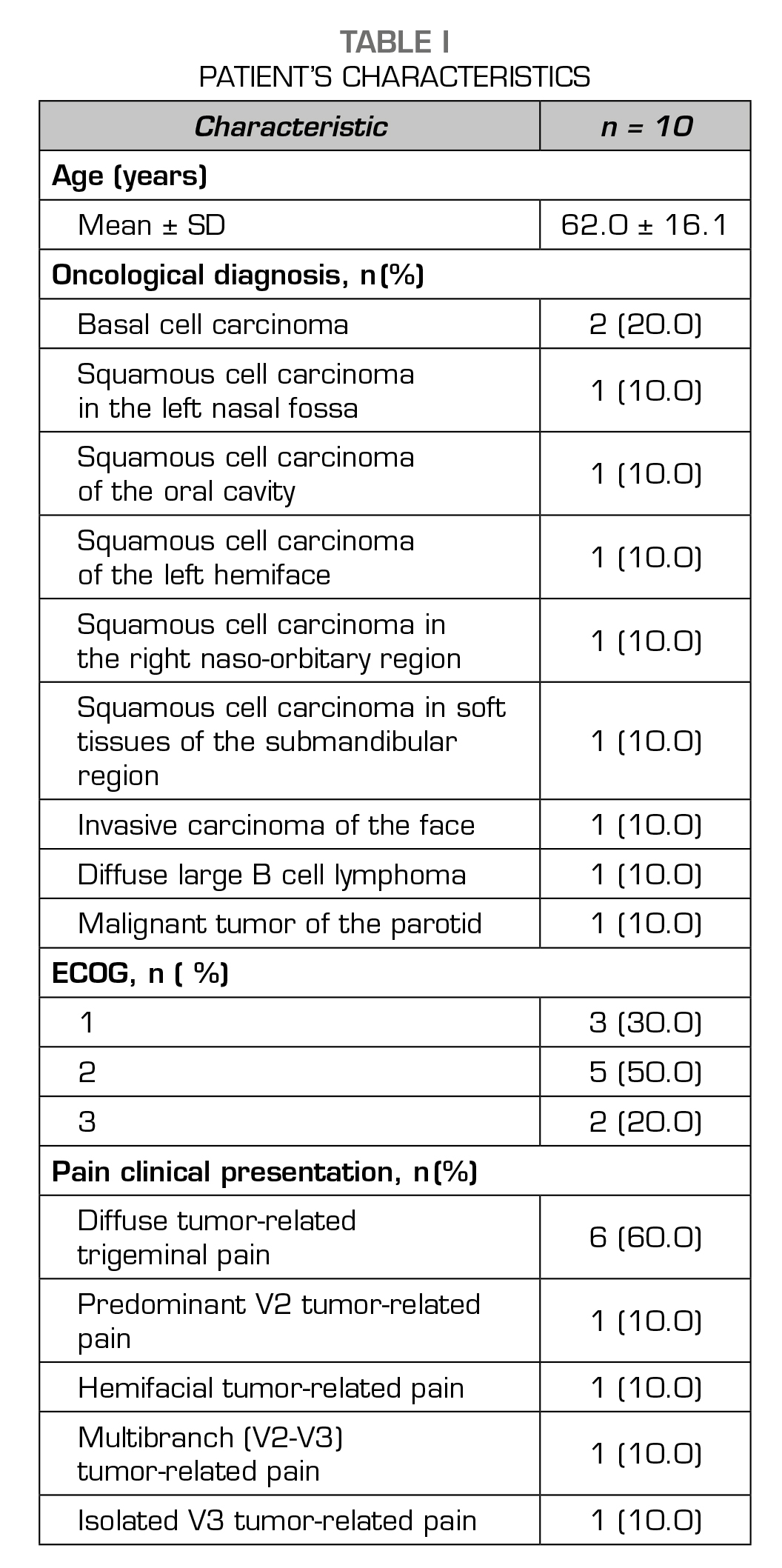
A total of 10 patients were included, with a mean age of 62 ± 16.1 years (range: 28-81 years). All patients presented tumor-related trigeminal pain secondary to head and neck malignancies. Regarding clinical presentation, 60 % had diffuse tumor-related trigeminal pain, 10 % had predominant V2 tumor-related pain, 10 % presented hemifacial tumor-related pain,10 % had multibranch (V2-V3) tumor-related pain, and 10 % had isolated V3 tumor-related pain (Table 1).
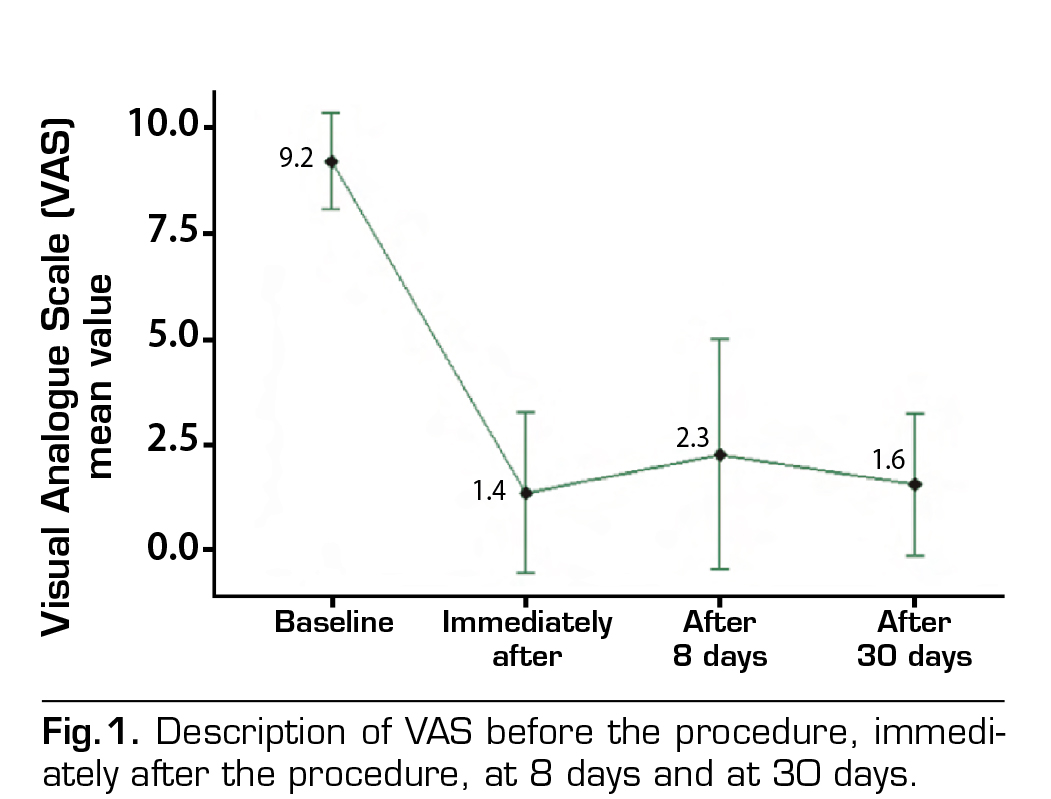
Pain was evaluated using the visual analogue scale (VAS), prior to the procedure with VAS on average 9.20 ± 1.14, VAS immediately after the procedure on average 1.40 ± 1.90, VAS eight days after the procedure with an average of 2.30 ± 2.71 and VAS at 30 days on average 1.60 ± 1.67 (Figure 1), respectively.
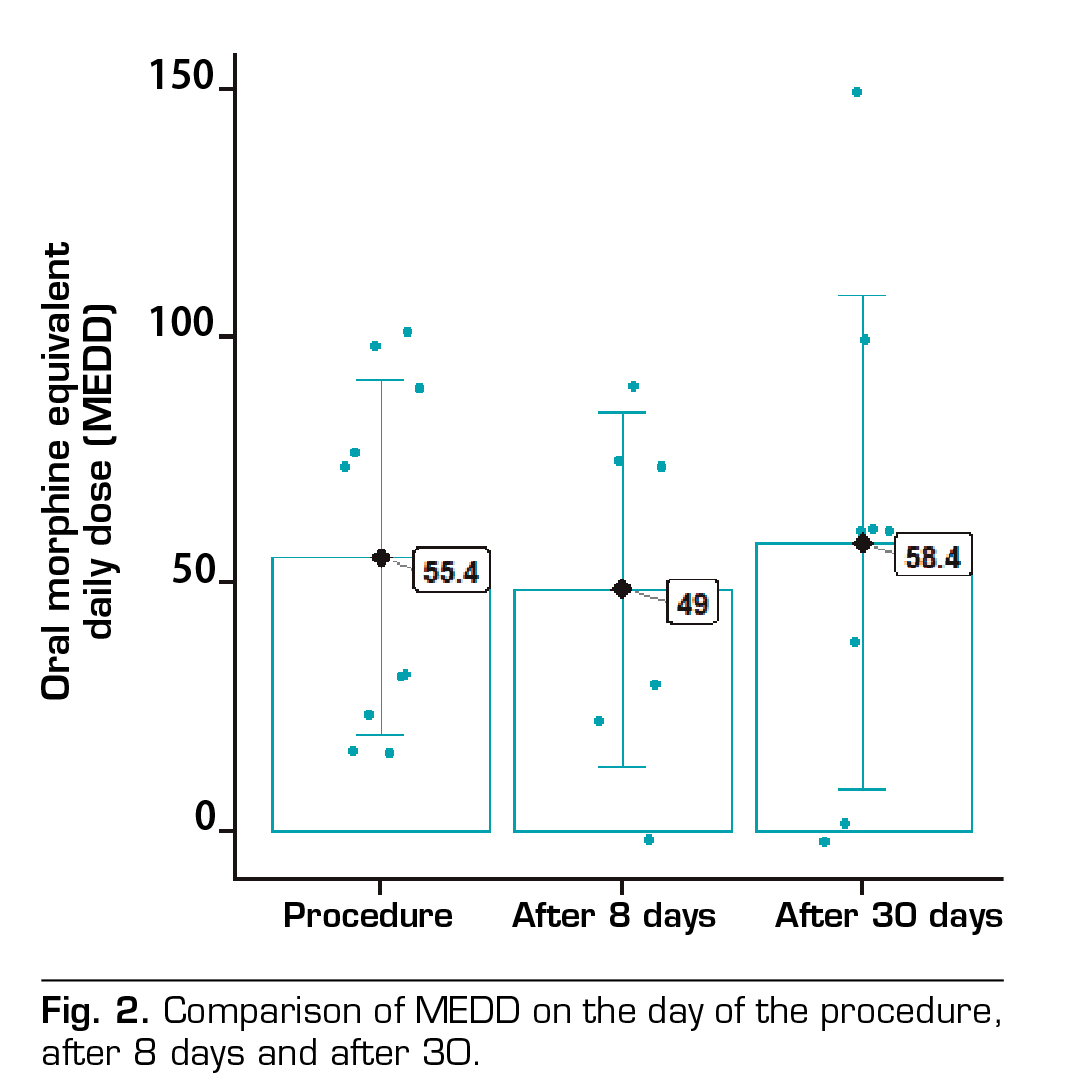
We also evaluated the oral morphine equivalent daily dose (MEDD) in the same time frame, with the following findings: MEDD on the day of the procedure with an average of 55 milligrams of morphine, MEDD at 8 days with an average of 49 milligrams of morphine, MEDD at After 30 days, with an average of 58.4 mg, we noted an increase compared to the day of the procedure, however with a decrease in VAS compared to the procedure without requiring additional analgesic interventions, used before the procedure (Figure 2). No immediate or delayed adverse effects were reported at the time of the procedure, nor at 8-day or 30-day follow-up evaluations.
DISCUSSION
Among the multimodal analgesic strategies, such as the use of neurolysis and pulsed radiofrequency in the territory of the three branches of the trigeminal nerve, which allows relief of cancer-related facial pain and improves quality of life of these patients (2), as we observed in the case report by Silva-Ortiz et al., where a patient in the eighth decade of life was taken to bipolar pulsed radiofrequency in the territory of V2 and V3 with complete improvement in pain that was maintained for 6 months after the procedure with recovery of the ability to swallow, speak, and chew (3); Another example was reported by Khawaja et al., in which 33 patients with a diagnosis of head and neck neoplasms were treated with chemical neurolysis with 75 % improvement in the first month in 72.7 % of the patients treated (4). There is no doubt that it is a good option for the management of nociceptive pain with a low risk of adverse effects such as facial numbness, chewing weakness in 4 % of cases, and a rare possibility of neuropathic pain of less than 1 % (5). Another therapeutic alternative is management by outpatient palliative care, as described in the study by Saravia-Kong et al., who found that patients with oncological pathology of the head and neck are more likely to undergo outpatient palliative follow-up, where they also describe the use of high doses of opioids and neuromodulators, such as gabapentin (6).
Craniofacial pain due to an occult neoplastic process is relatively rare, occurring in less than 20 % of cases, and is often due to direct neural invasion, compression, invasion of adjacent structures, and alteration of the vasculature, as observed in the study conducted by Van et al.; however, according to this study, symptomatic improvement was achieved in the vast majority of patients (97 %) with an adequate therapeutic approach (7).
One of the most important pathologies of this type of pain is Trigeminal Neuralgia, for which there is evidence in the literature that through alcohol neurolysis of the Gasser ganglion, effective analgesic control is achieved, which is why it is part of ablative therapies in patients who do not respond to pharmacological management (8).
Radiofrequency ablation is a widely used percutaneous ablative technique for trigeminal neuralgia because it allows controlled lesion size and is associated with lower recurrence rates (9). However, in patients with advanced oncological disease, the therapeutic objective differs from that of classical trigeminal neuralgia. Chemical neurolysis with alcohol offers several advantages in the palliative setting: it is technically simpler, requires shorter procedural time, does not require specialized radiofrequency equipment, and is more cost-effective. These characteristics are particularly relevant in frail patients with limited life expectancy or in healthcare settings with restricted resources.
On the other hand, alcohol neurolysis has limitations, including less predictable lesion extension and a potentially higher risk of sensory deficits or dysesthesia compared with radiofrequency thermocoagulation. Therefore, patient selection is essential. In our series, the aim was rapid and sustained analgesia with minimal procedural burden, making chemical neurolysis an appropriate alternative within a palliative care context rather than a substitute for radiofrequency in benign trigeminal neuralgia.
There are reports of complete relief of symptoms in up to 99 % of patients, as observed in the study carried out by Han et al. (10); thus, it is a possible analgesic tool available for older adult patients with comorbidities or those who do not wish to undergo surgical interventions, as observed in the study by Shah et al. (11).
Our case series focuses on oncology patients with head and neck neoplasms, which represent 5 to 10 % of neoplastic diseases, of which only 35 % are cured (excluding lip and larynx cancer), being a major cause of morbidity and mortality in patients due to the high impact they generate on the quality of life, affecting the ability to eat, breathe and speak (12,13), additionally according to the epidemiological report published by Gupta et al., In 2016, the current and future burden of head and neck neoplasms was increasing in low- and middle-income countries, where health systems are not sufficiently prepared to treat all patients affected by this pathology, generating greater morbidity and mortality (2), additionally, its impact has been observed in the reduction of social functioning, related to the dissemination of the primary tumor, due to the consequences of surgery or by developing oral mucositis as a toxic effect of radiotherapy, generating the need for professionals to evaluate palliative care needs early within the initial treatment planning and throughout the illness (13).
Taking this into account, multimodal analgesic approaches and more invasive therapies are necessary for patients who do not achieve symptomatic relief with pharmacological therapies alone and who achieve between 10 and 20 %, including nerve blocks, intrathecal infusions, and radiofrequency (3). Therapeutic nerve blocks can be non-neurolytic, to which bupivacaine is most frequently administered, or neurolytic, to which the most used substances are alcohol or phenol, to destroy the nerve fiber and block the transmission of the pain signal (8). Another reported strategy is the DREZ (Dorsal Root Entry Zone) operation of the caudate nucleus, which is a useful neuroablative procedure for the management of refractory facial pain with a higher success rate in the immediate postoperative period (up to 90 % of cases). Notably, patients with postherpetic neuralgia had the best long-term results, with a success rate of 71 %, as described in a study by Rossitch-Zeidman et al. (14).
This case series presents ten patients with head and neck neoplasia who underwent neurolytic Gasser ganglion block with absolute alcohol as part of a multimodal strategy to alleviate severe facial pain. All patients exhibited an improvement in pain after the procedure, exceeding 4 points on the analog numerical scale. Additionally, five patients demonstrated a decrease in opioid consumption. However, one patient died, one required reintervention, and another needed palliative surgery for symptomatic control. Importantly, all patients reported improvements in refractory pain according to the numerical analog scale, with no adverse effects associated with the block.
Oncological diseases involving craniofacial compromise, characterized by facial deformity, lead to severe pain that significantly impacts patients’ quality of life. Such cases necessitate multimodal analgesic plans incorporating interventional strategies. Gasserian ganglion neurolysis emerges as an effective and safe option for managing pain in these neoplasms, as indicated by the study’s findings of decreased opioid consumption and reduced pain levels expressed through the visual analogue scale reported by patients. Given the limited literature on this subject both nationally and globally, this experience contributes to advancing knowledge and provides a valuable field for study and research that benefits both patients and the academic community.
The authors declare that they did not receive any funding or financial support from public, private, or non-profit organizations for the development of this work.
FUNDING STATEMENT
The authors declare that they had no funding.
REFERENCES